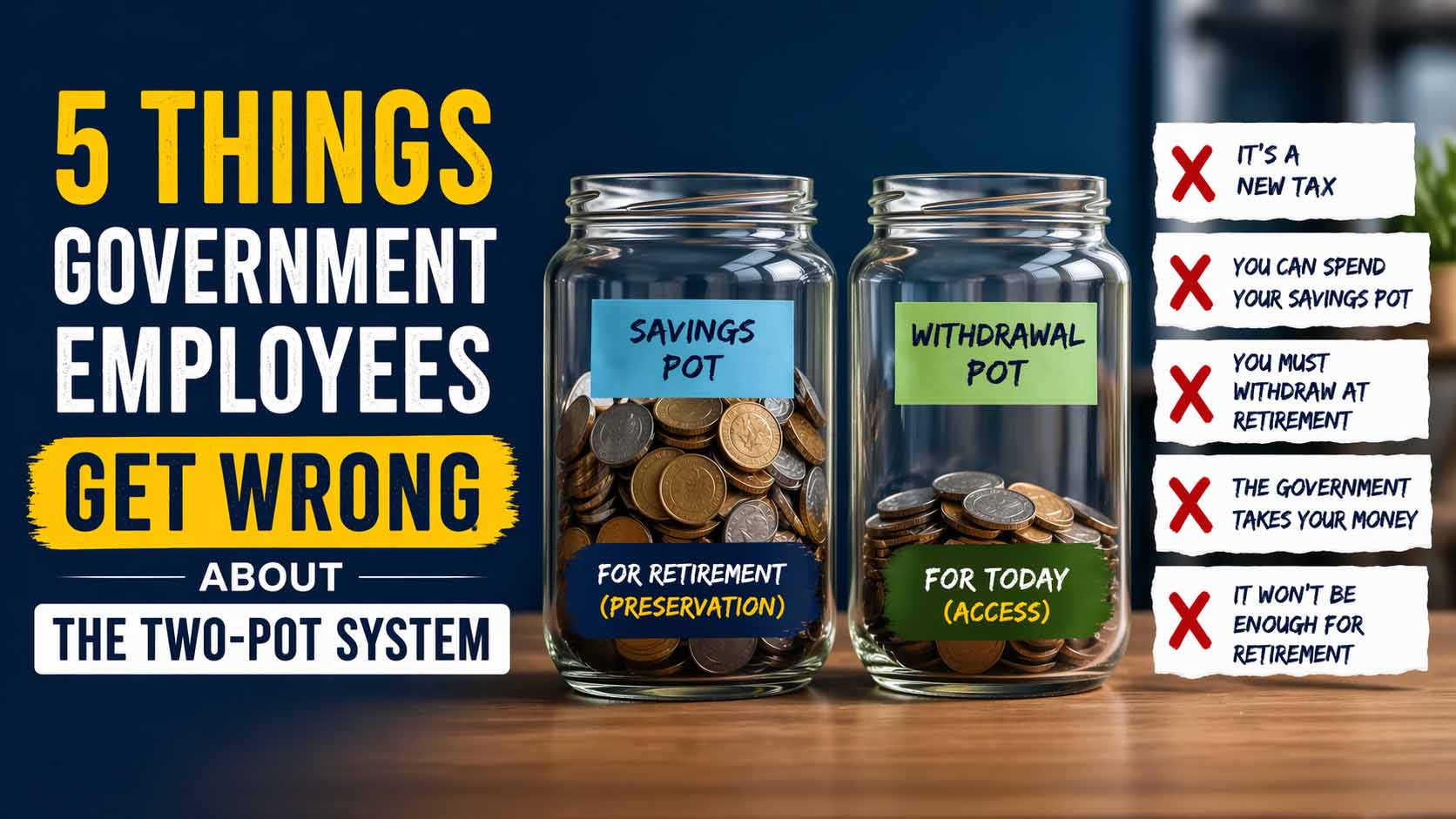
The Two-Pot system was meant to help government employees. But if you misunderstand it, it could quietly undo decades of hard work.
On the surface, it sounds like flexibility. Relief. Even a safety net. But the truth is, this system exposes financial behaviour. And for many government employees, that exposure is going to lead to regret.
Since the Two-Pot system launched, billions of rands have already been withdrawn. Most of those members made their decision without understanding the five things I am about to share with you.
Watch the full testimonial video here:
1. The System Is Not the Problem. Your Behaviour Is.
This is the one most government employees get wrong first. They blame the system. But the Two-Pot system is neutral. It does not reward, and it does not punish. The outcome depends entirely on what you do with it.
Discipline leads to protection. Impulse leads to regret. The system does not hide your habits. It exposes them.
Before the Two-Pot system existed, you could only access your pension benefits when you resigned or retired, and the earliest you could do that was at age 55. That limitation forced a kind of discipline. You had no choice but to leave the money alone.
Now, a portion of your savings is accessible every single year, even before 55. That sounds like freedom. But freedom without understanding is where the danger lives.
The question is not whether you can access the money. The question is whether you should.
Every rand you leave untouched continues to grow inside the fund. Every rand you take out stops working for you permanently. The Two-Pot system gives you a choice. But a choice without context is just a gamble.
2. Small Withdrawals Create Big Future Gaps
This is the mistake that catches most government employees off guard. A R30,000 withdrawal sounds small. It feels manageable. But your pension fund does not work like a savings account.
Pension funds work on formulas. The money you withdraw now does not just disappear from a balance. It affects the calculation that determines what you receive when you eventually resign or retire. That R30,000 today could cost you significantly more when you leave government service.
Most members will not realise the damage until they get their final payout and see a number far lower than what they expected. By then, the decision is irreversible.
If you are considering a Two-Pot withdrawal, the first question to ask is not “how much can I take out?” The first question is “what will this cost me when I leave?”
This is especially important for government employees with long service records. If you have 20 or 25 years of service, the formula that calculates your resignation or retirement benefit is directly affected by the balance in your fund. A small withdrawal today does not create a small impact tomorrow. It creates a compounding one.
3. The Tax Table Is Not What You Think
This is where many government employees get a nasty surprise. When you hear “pension tax,” most people think of the special retirement tax table. That is the one with the R550,000 tax-free threshold. It sounds generous.
But that table only applies when you formally exit the fund at age 55 or older through retirement.
When you make a Two-Pot withdrawal, it is taxed differently. Your withdrawal gets added to your annual income and taxed at your marginal income tax rate, the same rate as your salary. If you are already earning a decent government salary, that withdrawal pushes you into a higher tax bracket.
The result is that you hand over a much larger portion of your withdrawal to the taxman than you expected. Many government employees apply for R30,000, do the mental arithmetic expecting to lose a small percentage, and then receive far less than they planned for.
Understanding which tax table applies to your situation is not optional. It is the difference between making an informed decision and making an expensive one.
This catches many government employees off guard because they have heard about the R550,000 threshold and assumed it would apply to their withdrawal. It does not. The retirement tax table and the withdrawal tax table are two completely different things. Knowing which one applies to you, and when, could save you tens of thousands of rands.
4. The Taxman Takes His Cut First
This one surprises almost everyone. If you owe anything to the taxman, that debt gets deducted from your Two-Pot withdrawal before you see a single cent.
It does not matter what you planned to use the money for. If there is an outstanding tax liability on your profile, it comes out first. Many government employees apply for their withdrawal expecting a certain amount, only to receive a fraction of it because the taxman took his portion before the money reached their account.
This is not something that gets flagged during the application process. It happens at the back end, and by the time you find out, it is already done.
Before you apply for any Two-Pot withdrawal, check your tax status. Know what you owe. Because if you do not, the taxman will take what he is owed whether you planned for it or not.
This also applies to any outstanding assessments or corrections from previous tax years. If your tax affairs are not up to date, a Two-Pot withdrawal is one of the fastest ways to find out, because the deduction happens automatically.
5. This Is Not a Decision to Make Alone
The biggest mistake government employees make with the Two-Pot system is treating it as a simple, isolated decision. “It is just R30,000. What is the harm?”
The harm is that pension fund rules, tax tables, service formulas, and resignation benefits are all interconnected. A withdrawal from the savings pot affects your future pension calculation. The tax you pay on the withdrawal affects your annual tax return. The timing of the withdrawal affects which tax year it falls in.
This is not a decision to make at the kitchen table after reading one article. It is a decision that requires someone who understands the government pension fund rules, the formulas, and the long-term impact of each choice.
A specialist can show you exactly what a withdrawal will cost you, not just today, but when you eventually resign or retire. That clarity is the difference between a decision you are comfortable with and one you regret for years.
Government employees who go through a proper planning process before making any pension decisions consistently come out better than those who act on impulse or incomplete information. This is not about being told what to do. It is about having the full picture so that whatever decision you make, you make it with confidence.
What Should You Do Before Touching Your Two-Pot Savings?
If you are a government employee considering a Two-Pot withdrawal, or if you have already made one and want to understand the impact, the most important thing you can do is get the full picture before your next move.
The five mistakes above are not rare. They are happening right now, across every government department in South Africa. Teachers, nurses, police officers, and civil servants are all facing the same decision. And the ones who take the time to understand the rules before acting are the ones who come out ahead.
You have spent years, possibly decades, building your pension. The Two-Pot system gives you a new set of options. But options without understanding are just risks with a different name.
The Retire vs Resign Masterclass™ is designed specifically for government employees. It covers the Two-Pot system, the tax implications, the pension fund formulas, and the resign vs retire decision in detail.
Join The Retire vs Resign Masterclass™ and discover the full truth about your pension.
If you prefer to work through your specific numbers with a specialist, you can book a VIP Consult here →
The Two-Pot system is not going away. But the decisions you make with it are permanent. Make them with the full picture.