Introduction
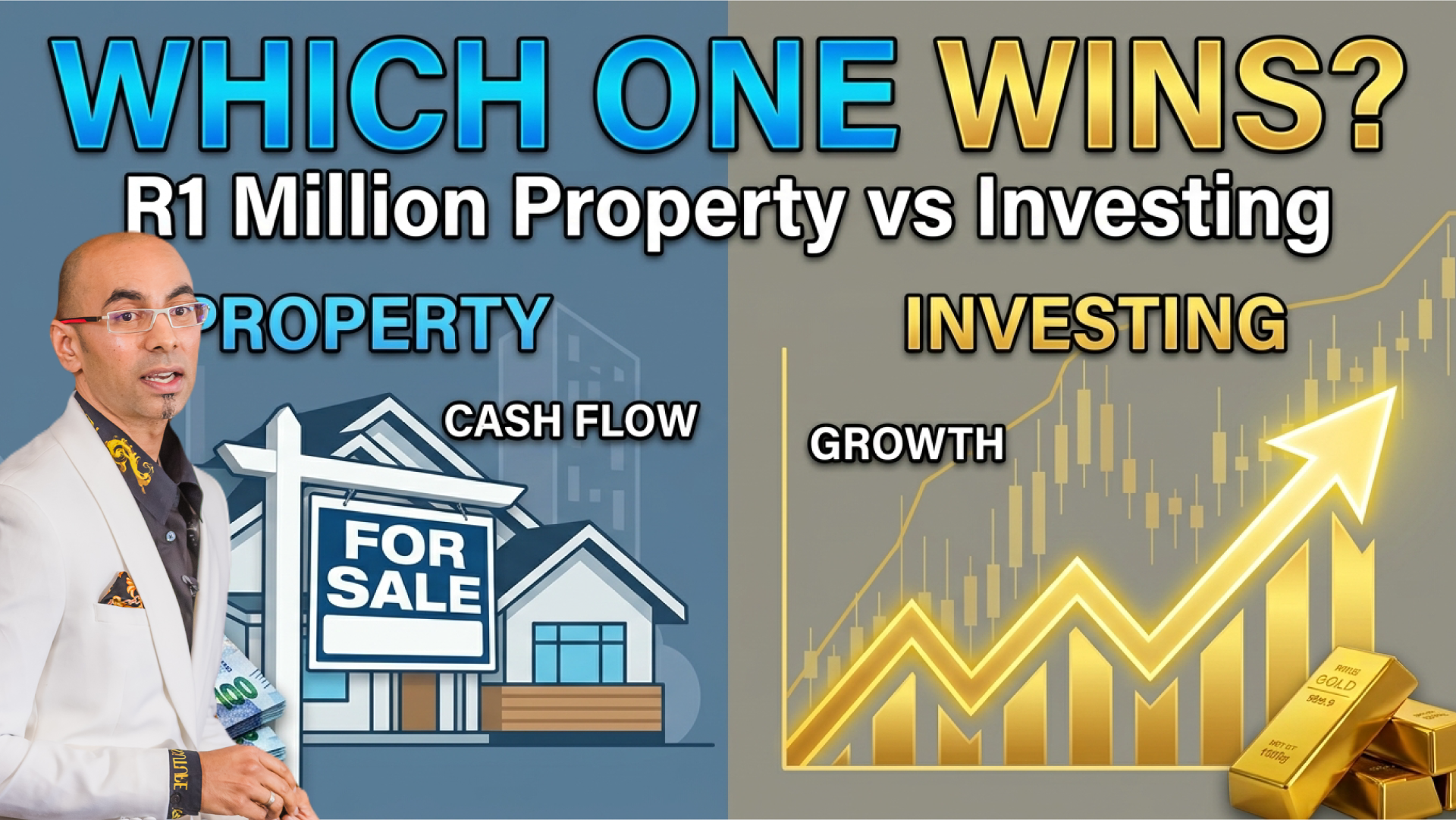
If you had R1 million available, would you buy a property or invest the money?
It sounds like a simple question.
A property is tangible. You can see it, rent it out, and potentially earn a monthly income from it.
If a R1 million property produces R10,000 per month in rental income, the numbers look attractive.
R10,000 multiplied by 12 months gives you R120,000 per year.
On a very basic calculation, that looks like a 12% annual return.
So does that mean property automatically wins?
Not necessarily.
The return is only one part of the decision.
Start With The Full Financial Picture
In the example discussed in the video, someone had approximately R2.1 million sitting in a retirement fund and wanted to know whether some of that money should be used to buy a property worth R1 million.
The property could produce approximately R10,000 per month in rental income.
On the surface, it looked like a strong opportunity.
But before making the decision, several other questions had to be answered.
How much money could actually be accessed?
What tax might apply?
What existing debt needed to be settled?
Would part of the property need to be financed?
How much money would remain invested afterwards?
And most importantly:
What would happen if the property did not perform exactly as expected?
These questions can completely change the answer.
The Money Available Is Not Always The Money You Think You Have
In the example, one-third of R2.1 million was approximately R700,000.
But R700,000 on paper does not automatically mean R700,000 is available to spend.
Tax may reduce the amount.
Existing debt may need to be settled.
In this case, there was also approximately R120,000 in debt to consider.
Once those amounts were taken into account, the money available for the property had already reduced significantly.
That meant there was not enough liquid cash to simply buy the R1 million property outright.
The balance would need to be financed.
And that creates another question.
Where will the bond repayment come from?
Your Remaining Retirement Money Still Has A Job To Do
After taking the cash portion, the balance of the retirement money still needs to support your future.
In the example, approximately R1.4 million would remain invested.
That investment may need to generate income.
If part of that income is then used to service a property bond, you need to ask whether the income withdrawal is sustainable.
Drawing too much from an investment can cause the capital to reduce over time.
That is why property versus investing should never be looked at as two completely separate decisions.
The property purchase can affect the amount of capital you keep invested.
The investment income can affect whether you can afford the property.
Everything needs to be considered together.
A 12% Return Does Not Tell The Whole Story
A property costing R1 million and earning R10,000 per month produces R120,000 in annual rental income.
On the surface, that looks like a 12% return.
But that is only a starting point.
You still need to consider the risks and costs that sit behind the number.
For example:
- What if it takes time to find a tenant?
- What if the tenant stops paying?
- What if the property is damaged?
- What if maintenance costs are higher than expected?
- What if the property stands empty for several months?
- What if you still have a bond payment during those periods?
None of these questions mean property is a bad investment.
They simply help you understand the risk more clearly.
Ask: What Is The Worst That Could Happen?
One of the most useful questions you can ask before making a major financial decision is:
What is the worst that could happen?
Not because you should expect everything to go wrong.
But because you need to know whether your financial plan can survive if something does.
If your entire retirement income depends on rental income arriving every month, then a vacant property or non-paying tenant becomes a much bigger problem.
If you have other investments, other income and experience managing property, you may be able to carry that risk more comfortably.
The investment itself may be the same.
Your circumstances are what change the decision.
Experience Matters
Someone who has owned investment properties for ten years may understand property risk very differently from someone buying their first rental property.
An experienced property investor may already know how to:
- Find and screen tenants
- Manage vacancies
- Budget for maintenance
- Understand financing
- Deal with property expenses
- Manage problem tenants
- Protect cash flow
For that person, another investment property may fit comfortably into an existing strategy.
For someone with no property experience and a retirement plan that depends heavily on the rental income, the same property could carry far more risk.
This is why financial advice should not simply say that property is good or investing is better.
The answer depends on the person.
Investments Have Risks Too
Choosing to keep the money invested does not remove risk.
Markets can fall.
Investment values can move up and down.
Income withdrawals can become too high.
Poorly structured investments can also create problems.
The objective is not to find an investment with no risk.
That does not exist.
The objective is to understand the risks and structure your money in a way that gives you the best chance of meeting your long-term needs.
Tax Planning Can Change The Outcome
Tax is another part of the decision that should not be ignored.
When money is accessed from a retirement structure, tax may apply depending on how the money is taken and your personal circumstances.
The important point is to calculate this before making the decision.
Do not start by deciding what you want to buy and then work out the tax afterwards.
Work out the tax first.
Understand what you may actually have available.
Then decide what options are realistic.
Good financial planning should aim to keep as much of your money working for you as legally possible.
Compare The Options Before You Commit
One of the most valuable things about financial planning is that you can model different scenarios before signing anything.
You can ask:
- What happens if I buy the property?
- What happens if I keep the money invested?
- What happens if the property is vacant?
- What happens if investment markets fall?
- How much income do I need each month?
- How much debt should I settle first?
- How much cash do I need available?
- How long does my money need to last?
You can work through these questions before committing your money.
That is the point.
You should not need to make the decision first and understand the consequences later.
Do Not Choose Based On One Number
A 12% return sounds impressive.
But one number is not enough to make a major financial decision.
You also need to think about:
- Tax
- Debt
- Income needs
- Liquidity
- Property experience
- Investment experience
- Market risk
- Property risk
- Long-term sustainability
- Your ability to absorb unexpected costs
The highest-looking return is not automatically the best investment.
And a good investment can still be the wrong investment for your circumstances.
Aim For Peace-of-Mind Money
The goal of financial planning should not simply be to chase the biggest return.
The goal should be to create what Dhevan calls peace-of-mind money.
That means structuring your money in a way that gives you the income you need without exposing you to risks you cannot comfortably afford.
For one person, that may include property.
For another, it may mean keeping more money invested.
For someone else, it may involve a combination of both.
The right answer depends on your numbers, your experience, your income needs and your long-term financial plan.
Your Next Step
Before you use retirement money to buy property or make any other major investment decision, take time to compare the options properly.
Do not ask only:
Which option gives me the highest return?
Also ask:
Which option gives me the best chance of sustaining my income and protecting my financial future?
Watch the full video to see how Dhevan works through the R2.1 million example and why the R1 million property was not automatically the better option.
If you need personalised guidance around your retirement money, investments, tax or income planning, book a VIP Consultation with Retirement Wellness SA.
Book your VIP Consultation:
https://app.retirevsresign.co.za/consult
Author Bio
Dhevan Naicker is the founder of Retirement Wellness SA and the author of What They Don’t Want You to Know About Retiring or Resigning. He helps South Africans make smarter, more informed financial decisions, with specialist expertise in retirement, pension and financial planning.
Disclaimer
Retirement Wellness SA is a Trust and Authorised Financial Services Provider (FSP 31609). This content is shared for educational purposes only and does not constitute personalised financial advice.
Watch the full video and book your VIP consult:
Join The Retire vs Resign Masterclass™