Introduction
You may believe good things are possible for other government employees.
You may see another government employee driving a better car, travelling, spending time with family, or enjoying the results of many years of work, and think they deserve it.
But when the same idea turns toward you, something changes.
You may tell yourself that you should be grateful for what you have. You may say it can wait. You may decide that proper guidance, a better experience, or a more careful decision is not really for you.
That quiet belief can become expensive.
In this article, we look at why one R1.5 million tax mistake was not only about tax. It was also about worth, advice, dignity, and the question many government employees stop asking after decades of service.
What do I actually want for my life?
Why This Decision Matters Right Now
Government employees often spend years serving departments, colleagues, communities, and families before turning attention back to themselves.
That can create a pattern. You become used to putting your own needs last, even when the decision in front of you could affect your pension, your tax, and the quality of life you are trying to build.
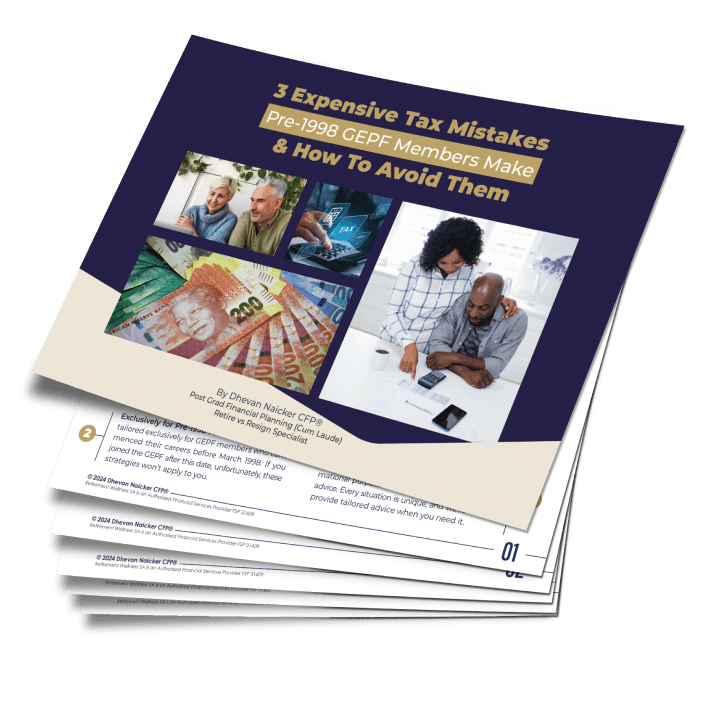
Dhevan Naicker shared a recent example of a government employee who had already left service and later reached out for help with tax. In the first five years, the tax position was over R1.5 million.
The point is not to make the government employee feel bad. The point is to ask what happened before the decision was made.
Sometimes the real cost does not begin with the taxman. It begins when a government employee believes that proper guidance is too much, too expensive, or not something they deserve.
Number 1: Ask What You Want
The question sounds simple.
What do I actually want for my life?
Many government employees are used to answering a different question. They ask what their family needs, what work expects, what colleagues are doing, or what society says they should accept.
Those questions may matter, but they are not enough.
Dhevan explains that the question is not only about whether you should retire or resign. It is bigger than that. It is about your life, your priorities, your family, your health, your finances, and the future you are trying to build.
When you are clear about what you want, decisions become easier to assess. You can ask whether an opportunity, a recommendation, or a plan actually matches the life you want.
Without that clarity, you may accept whatever is presented because it feels familiar or safe.
Government employees who ask better life questions are more likely to make better financial decisions.
Number 2: Notice When You Settle
Settling often does not feel like settling at first.
It can feel like being practical. It can sound like, “I should not spend this on myself,” or “I will deal with this later,” or “I should just be grateful for what I have.”
Dhevan shared his own story about wanting to study later in life. The difficulty was not only whether he could pay for it. The deeper question was whether he should spend money on himself or keep it for his family.
That is a familiar pattern.
Government employees may spend so much time providing, serving, and supporting others that doing something for themselves can feel uncomfortable. Even when it could improve the service they give, the advice they receive, or the decisions they make, they may hesitate.
The problem is that major financial decisions do not wait until you feel completely comfortable.
If you keep settling for less, the cost may only become clear after the decision is already made.
Number 3: Better Advice Has Value
A consult fee can feel uncomfortable when you focus only on the price.
But the better question is what the right guidance can help you avoid, understand, or prepare for before a major decision is made.
In the transcript, Dhevan explains that one government employee avoided a consult fee, yet later may have faced more than R1.5 million in tax over the first five years.
That does not mean every consult produces the same result. It also does not mean every decision can be changed afterward.
It means the price of advice should be weighed against the possible cost of acting without enough clarity.
Government employees should be careful before treating all advice as equal. A lower price may feel easier in the moment, but the more important question is whether the advice is suitable, careful, and informed.
The cost of guidance is visible upfront. The cost of a poor decision may only appear later.
Number 4: Dignity Changes the Experience
The Durban ICC masterclass story matters because it was not only about a venue.
Dhevan explained that the team made a deliberate decision to create a better experience for government employees. The point was not to impress for the sake of appearance. The point was to treat government employees with dignity and respect.
The experience included a proper venue, food, sound, recording, photography, packs, and a copy of Dhevan’s book. The cost to deliver the experience was far higher than the ticket price.
Why would a business do that?
Because the message behind the experience was important. Government employees are worthy of being treated well. They are worthy of better service. They are worthy of sitting in a room that reflects value, not an afterthought.
That matters because repeated low-quality experiences can quietly shape what a government employee believes is normal.
When government employees are treated with dignity, it becomes easier for them to believe their future deserves dignity too.
Number 5: Worth Affects Financial Choices
Worthiness can sound emotional, but it can influence very practical decisions.
If you believe you are not worthy of the best guidance you can reasonably access, you may delay help. You may choose the cheapest route. You may avoid asking questions because you do not want to inconvenience anyone.
That can lead to decisions made with incomplete information.
Dhevan asks a direct question in the video: are you worthy of getting the best?
This does not mean spending recklessly. It does not mean taking on debt to look successful. It means asking whether you are giving your future the level of care it deserves.
For government employees approaching a major retire-or-resign decision, this matters deeply.
Your pension decision is not only an administrative step. It can affect your tax, your future income, your family, and your ability to live the life you have worked toward.
If you undervalue yourself, you may undervalue the decision too.
Number 6: Plan Before It Is Too Late
Some decisions are easier to improve before they are made.
That is why planning matters. Waiting until after leaving service can reduce the options available and make it harder to correct mistakes.
Dhevan’s example of the R1.5 million tax position is a reminder that the timing of advice can be just as important as the advice itself.
Government employees should not wait until the paperwork is complete before asking serious questions. By then, the conversation may become about damage control instead of planning.
Careful planning does not require panic. It requires honesty.
What do you want? What makes you happy? What kind of life are you trying to build? What advice do you need before making a decision that may affect the next stage of your life?
Planning early is one way of showing that your future deserves proper care.
Your Next Step
If you have read this far, you are already doing something important.
You are not only thinking about tax, fees, or products. You are thinking about the beliefs behind the decision.
That matters because government employees can spend decades serving others, then hesitate when it is time to choose better guidance, better planning, or a better experience for themselves.
The full video gives more depth to this conversation. Dhevan shares the personal story that shaped his thinking, the Durban ICC experience, and the R1.5 million tax example that shows why the deeper question matters.
Watch the full video and register for The Retire vs Resign Masterclass™
The video is not about fear. It is about dignity, worth, and asking better questions before a major retire-or-resign decision is made.
No panic. No fluff. Just the truth.
Watch the full video and book your VIP consult:
Join The Retire vs Resign Masterclass™