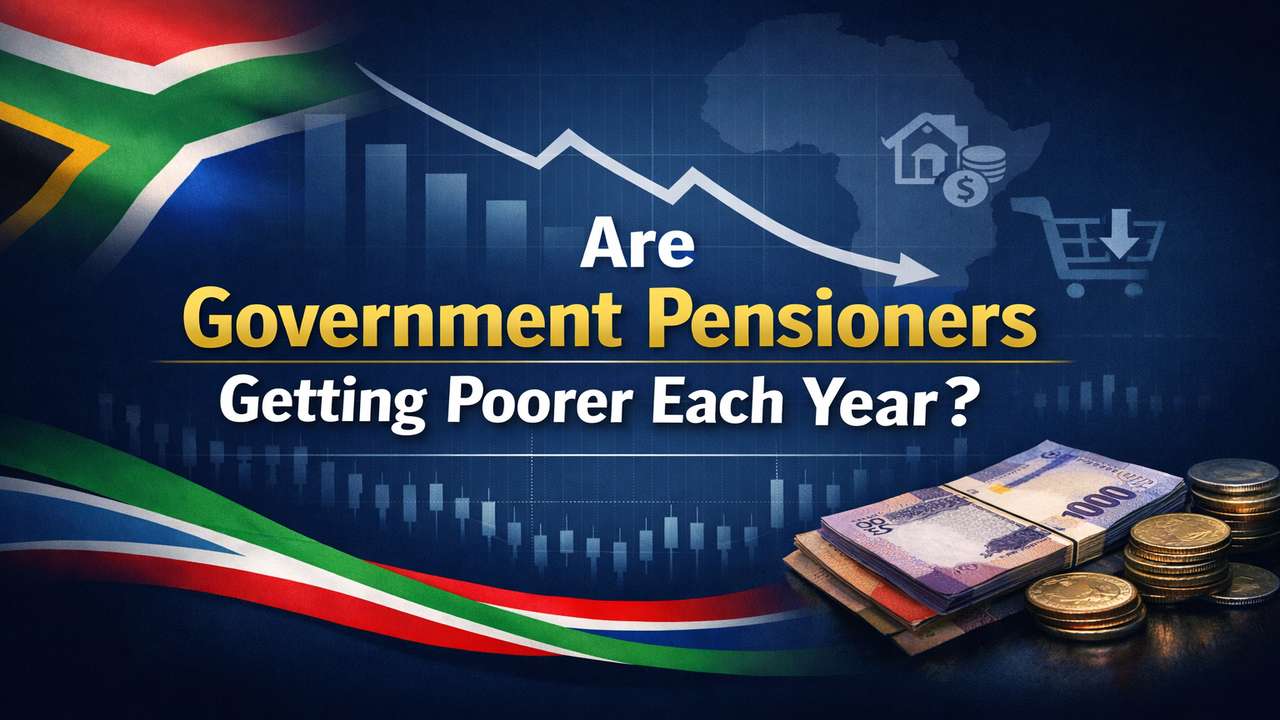
Your government pension went up 3.5% this year. Electricity went up 8.76%. Medical aid went up 9.5%. Meat went up 31%. And fuel is about to go up by more than R5 per litre.
So let us ask the uncomfortable question: are government pensioners getting poorer every single year, even while receiving an annual increase?
The short answer is yes. And the numbers make it impossible to ignore.
In this post, we break down exactly what is happening, share a real story from someone living through it, and give you five practical things you can do if you are still a government employee and want to protect your financial future.
Watch the full video breakdown:
1. The 3.5% Increase That Feels Like a Pay Cut
Every year, government pensioners receive what is described as an inflation-linked increase. This year, that increase was 3.5%. On paper, that sounds reasonable. It sounds like an effort to keep pace with the cost of living.
But when you look at what pensioners are actually spending their money on each month, the picture changes completely.
Electricity is up 8.76%. That is more than double the pension increase. For a pensioner living at home full time, electricity is not a luxury. Cooking, heating, refrigeration and lighting are basic necessities. An increase of 8.76% hits hard when your income only moved 3.5%.
GEMS medical aid contributions went up 9.5%. Nearly three times the pension increase. Medical aid is not something most pensioners can afford to cancel. As you age, the need for medical coverage increases, not decreases. So this is a cost that is going up faster than income with no realistic way to cut it.
Meat prices have risen by 31% over the same period. Protein is not a luxury. For pensioners who grew up in a culture where a proper meal includes meat, absorbing a 31% price increase on top of stagnant income is genuinely damaging to quality of life.
Fuel is set to increase by over R5 per litre. This affects everything. Not just driving, but the cost of every product that is transported to shops, delivered to homes, or picked up from markets. Fuel increases are embedded in the price of almost everything else.
This is the reality: the 3.5% pension increase does not just fail to keep pace with inflation, it falls short of almost every single major cost category that pensioners actually spend money on. The gap between what pensioners receive and what it costs to live is not narrowing. It is widening every year.
And for people on a fixed income, there is no way to earn more. There is no side hustle to fall back on. There is no salary review coming. There is only what arrives in the bank at the start of the month, and the mounting costs that eat through it before the month is out.
2. The Pension Fund Earned 14.1%. Pensioners Got 3.5%.
Here is where things get really uncomfortable. The pension fund reported an investment return of 14.1% in the most recent financial year.
Pensioners received 3.5%.
The gap between what the fund earned and what pensioners received is 10.6 percentage points. That is a significant difference. And it raises a question that many pensioners feel but few ask out loud: if the fund grew by 14.1%, why did my pension only go up 3.5%?
Now, there are actuarial and structural reasons why the full return does not flow directly to pensioners. The fund operates as a defined benefit fund, which means your pension is based on a formula, not directly on investment returns. The fund also has long-term obligations to current and future pensioners that require it to hold back a portion of returns as reserves.
But here is the part that matters most for current government employees: two thirds of your pension capital is invested. That means investment performance is directly linked to what eventually gets paid out. And because the fund is managing enormous long-term obligations, the investment strategy that is chosen for your money matters far more than most people realise.
The result is this: the fund is growing, your money inside the fund is working, but the growth is not flowing back to you as a pensioner in any meaningful way. Your spending power is shrinking on the outside, while the numbers on paper continue to grow on the inside.
For government employees who have not yet retired, this is a critical lesson. What happens to your capital between now and your retirement date, and how the fund performs in those final years, will have a significant impact on what you eventually receive. It is why understanding the investment side of your pension is not optional. It is essential.
It is also worth knowing that the two-pot retirement system has changed the landscape for those who are still employed. If you have accessed your savings component, even a partial withdrawal can affect your benefit calculations at retirement. Every decision you make now has consequences later.
3. Meet Mrs Ndlovu: A Story Shared by Thousands
Mrs Ndlovu is 67 years old. She retired after a full career as an educator. She did everything right. She served her community, showed up every day, contributed to her pension every month for decades, and retired with the expectation that her pension would carry her through her golden years.
By the 20th of every month, her pension has run out.
She is not reckless with money. She is not making extravagant purchases or living beyond her means. She does not have a lavish lifestyle. She is simply a woman trying to cover her electricity bill, her medical aid contribution, her food, and a few other basic household expenses on a pension that no longer stretches far enough to do so.
What makes her situation particularly painful is that she did everything society told her to do. She contributed faithfully. She worked a full career. She planned to live off her pension. And now, at 67, she is running out of money before the month ends.
Mrs Ndlovu is not an isolated case. She is the representative of hundreds of thousands of government pensioners across South Africa who are experiencing exactly the same thing. The names change, the departments change, the provinces change. But the story is the same.
Retired teacher. Retired nurse. Retired police officer. Retired clerk. All of them facing the same quiet crisis: a pension that was supposed to last the month but does not. A life of service that deserved more than this outcome.
The tragedy is not that the system is broken. The tragedy is that most of these people had no warning, no planning support, and no one to tell them that the 3.5% increase they would receive in retirement would not keep pace with the world they would be retiring into.
And while nothing can be done for those already in this position except to manage it as best as possible, there is a great deal that can still be done for those who have not yet retired. The window to plan is open. But it will not stay open forever.
4. Why the Investment Strategy Behind Your Pension Matters More Than You Think
Most government employees think of their pension as a savings account. You put money in. You work your years. You retire. You get paid out. Simple.
But two thirds of your pension capital is invested. And how that capital is invested, and what return it earns, directly affects the size of the fund and, by extension, the sustainability of the increases that pensioners receive over time.
When the fund earns 14.1%, and pensioners receive 3.5%, the difference does not disappear. It is retained in the fund to cover future obligations, to build reserves, and to manage the enormous responsibility of paying millions of current and future pensioners for potentially decades. That is how a defined benefit fund works.
But here is why it still matters to you as an individual: your resignation benefit, if you choose to resign instead of retire, is calculated on the fund value that your years of service have accrued. And that value is sensitive to the fund’s overall performance, the timing of your exit, and how the actuaries have adjusted the fund’s benefit structures in the most recent review.
Benefit adjustments happen approximately every three years. Those adjustments can go up, but they can also go down. If values are adjusted downward, you could receive less than you expected, even after working longer. This is a reality that very few government employees are ever told.
This is also why the timing of your exit from government service is not something to leave to chance or to rush into based on a rumour, a colleague’s advice, or a number that HR mentioned in passing. The difference between resigning in the right month and resigning in the wrong month can amount to tens of thousands of rands. And the difference between retiring and resigning, depending on your age, your service years, and your financial position, can be life-changing.
The investment strategy at a fund level is not something you can control. But the decision-making strategy at your personal level absolutely is. And understanding how the two connect is one of the most valuable things any government employee can do before they exit.
5. Five Things Every Government Employee Must Know Before They Retire or Resign
Whether you are approaching retirement age or beginning to think seriously about resignation, these five points could be the most financially significant things you ever engage with. They are not complicated. But they are things that most government employees have never been told.
1. Know the difference between retiring and resigning.
This is the foundation of everything else. Retiring and resigning from government service are not the same thing. They are taxed differently. They pay out differently. They affect your future income differently. And they have completely different long-term consequences depending on your age, your years of service, and your financial situation.
Too many government employees treat these two options as interchangeable, choosing whichever feels more natural in the moment. But making this choice without understanding the numbers behind each option is like choosing between two roads without knowing where either one leads.
For some people, retirement is clearly the better option. For others, resignation produces a significantly higher lump sum. The only way to know which is right for you is to calculate both, compare the outcomes, and make a decision based on facts, not assumptions.
2. Calculate your monthly shortfall before you retire.
Before you hand in any paperwork, sit down and work out exactly what your pension will pay you every month and exactly what your life costs. Do not estimate. Do not guess. Use real numbers.
Include your bond or rent, your medical aid, your electricity, your groceries, your transport, your debt repayments, your insurance, and any other regular expenses. Then compare that total to your expected monthly pension.
The gap between those two numbers is your monthly shortfall. And if you do not know what that gap is before you retire, you will discover it the hard way, like Mrs Ndlovu, after it is already too late to do anything meaningful about it.
Many government employees are shocked when they run these numbers for the first time. Not because the pension is negligible, but because the cost of living in retirement is far higher than they anticipated, particularly when medical aid and electricity costs are rising at the rates they currently are.
3. Understand how your pension is actually calculated.
Your pension payout is not simply what you contributed over your career. There is a formula. That formula takes into account your years of service, your final salary, the actuarial adjustments applied by the fund, and in some cases, two-pot withdrawals you may have made.
Most government employees have never been walked through this formula in plain language. They receive a statement, they see a number, and they assume that number is what they will receive. It is not always that simple.
Understanding the formula is not just an academic exercise. It changes the decisions you make. It tells you whether an additional year of service adds meaningfully to your benefit or whether it produces a marginal gain that does not justify the time. It tells you whether a resignation benefit would be higher or lower than a retirement benefit at your current service level. And it helps you time your exit for maximum financial benefit.
4. Plan specifically for medical aid costs.
Medical aid in retirement is one of the most underplanned expenses that government employees face. When you are still employed, your contribution is subsidised and deducted before you see your salary. It feels almost invisible.
When you retire, that subsidy structure changes. And medical aid costs, as we have already seen, are rising at 9.5% per year, well above the pension increase. Over a retirement that could last 20 to 30 years, the compounding effect of medical aid inflation on a fixed pension income is severe.
You need to model this out. What will your medical aid cost in five years? In ten? What happens if you develop a chronic condition and need to upgrade your plan? What is your out-of-pocket exposure if you downgrade to control costs?
These are not hypothetical questions. They are financial planning necessities. And the time to answer them is before you retire, not after.
5. Get fully informed before you make any decision.
This is the point that underlies all the others. Too many government employees make the most significant financial decision of their lives based on incomplete information. They resign because a colleague resigned. They retire because HR told them to. They choose a benefit option because someone at the fund mentioned it.
The consequences of getting this wrong follow you for the rest of your life. There is no going back. There is no renegotiation. Once the paperwork is submitted and the benefit is paid out, the decision is done.
Getting informed means understanding the full picture. It means knowing the tax implications of your choice. It means understanding your investment options. It means reviewing your specific numbers with someone qualified to interpret them. And it means making a deliberate, calculated decision, not a rushed or assumed one.
The information exists. The resources exist. The only question is whether you will access them before or after it is too late to act on them.
Take the Next Step
If this post has raised questions about your own retirement or resignation strategy, here are three ways to go deeper.
Online Masterclass: The Retire vs Resign Masterclass gives you the complete framework you need to understand your pension, your options, and the decisions that will shape the rest of your financial life. Register here →
In-Person Masterclass: If you prefer to learn in a live setting with the opportunity to ask questions face to face, join one of the in-person masterclass events. Register here →
VIP Consultation: If you want personalised guidance based on your specific benefits, years of service, and personal circumstances, book a one-on-one VIP consultation. Book your consultation →